
Ningxia Day 6: Film Sets, Ancient History and Goodbye to Ningxia
12 September 2025
It was my last day in Ningxia before flying back to Shanghai. We had two more places to visit: China Western Film Studios (镇北堡西部影城) and Shuidonggou (水洞沟).
CHINA WESTERN FILM STUDIOS (镇北堡西部影城)

One last day in Ningxia, starting at China Western Film Studios (镇北堡西部影城).
The film studio has been used for several famous Chinese movies, including A Chinese Odyssey《大话西游》, Red Sorghum《红高粱》, Ashes of Time《东邪西毒》and New Dragon Gate Inn《新龙门客栈》. It was quite cool to walk through the film sets and see the backdrops and props in person.

The city wall from A Chinese Odyssey《大话西游》, with figures recreating the memorable moment between 至尊宝 and 紫霞.

The entrance to Pansi Cave (盘丝洞), another familiar location from The Chinese Odysey《大话西游》.

The weathered Moon Gate (月亮门), one of the best-known locations from Red Sorghum《红高粱》.
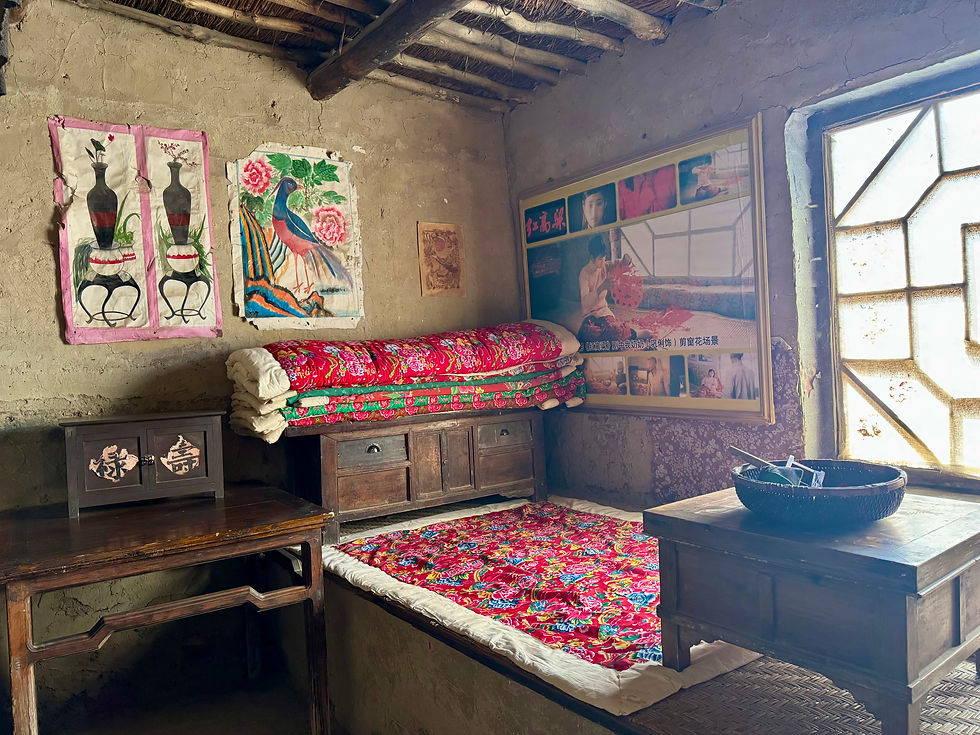
A room from Red Sorghum《红高粱》, with a display showing 九儿, played by actress Gong Li, in the paper-cutting scene.
A lot of visitors were posing for photos at the different filming spots. I was travelling solo and hadn’t brought a tripod, so I mostly wandered around and took a few photos here and there.

An old-school martial arts stage (擂台)—the kind where you expect someone to leap up and declare, ‘三招定胜负'!

Inside a traditional Chinese medicine shop set, with labelled drawers, hanging herbs and ceramic jars.

An elaborately decorated brothel set, complete with pink drapes, a balcony and a very dramatic bedroom.
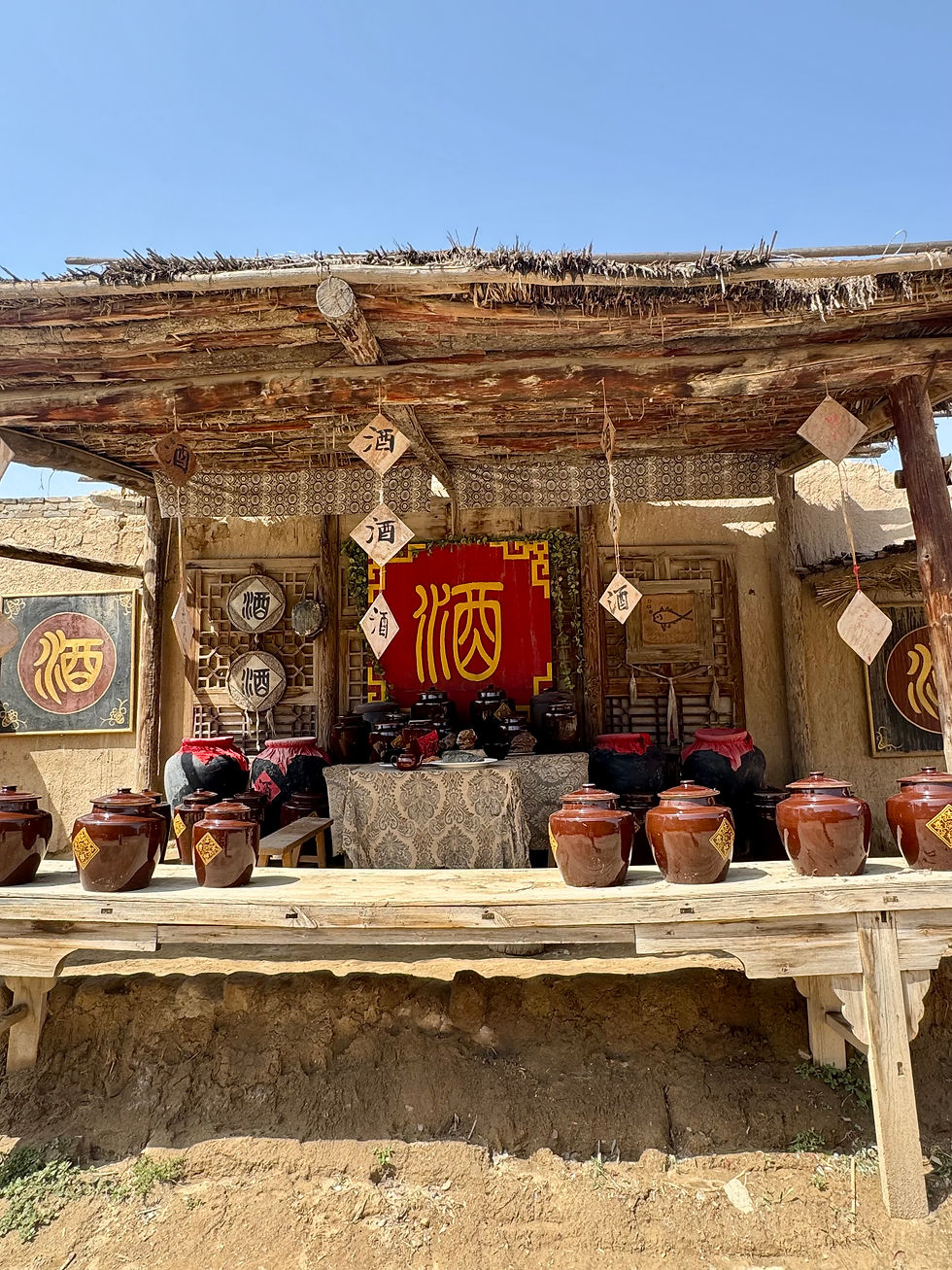
Wine jars lined up on a rustic set. I loved spotting these little details as I wandered around.
I thought it was an alright stop. If you recognise the films or enjoy taking photos, I think you’ll have much more fun here. If you aren’t familiar with Chinese films and aren’t particularly interested in filmmaking or photography, it might not be a must-visit.
SHUIDONGGOU (水洞沟)
Shuidonggou was a fascinating change of pace. The archaeological site dates back to the Palaeolithic, or Old Stone Age, with evidence of people living in the area around 40,000 years ago. The grounds are quite extensive, so there’s a lot more to explore than I initially expected.

Arriving at Shuidonggou (水洞沟).
Getting around the large site can be part of the experience: it offers horse-drawn carriages, camel rides or camel-drawn carts, and even boat rides and bamboo rafts. However, you do need buy the package tickets that include them.

The view from the horse carriage — one of the different ways we travelled around Shuidonggou!

Switching to a camel carriage for another part of the journey.

A cute camel chilling at Shuidonggou.
While on the ride, I wondered whether pulling a carriage full of passengers would be too much for the horses and camels. However, I learnt that the carriages are electric powered, although the animals still walk in front of them.

The Shuidonggou Site Museum (水洞沟遗址博物院), my first stop before exploring the much larger site.

One of my favourite things to discover at the Shuidonggou museum — tiny ornaments made from ostrich eggshell. People were making jewellery here thousands of years ago!

Reconstructed semi-subterranean homes, known locally as 地窝子, at Shuidonggou Village.

A recreated room furnished with wooden chairs, clocks and other everyday objects.

Old weighing scales and tools on display.
There was also a section of the Great Wall at Shuidonggou, which I was really surprised to find. This is part of the Ming Great Wall (明长城), built and strengthened during the Ming dynasty to defend the northern frontier. The Great Wall is actually a vast network of walls and fortifications constructed across different periods, and this stretch belongs to the section that runs from the Yellow River through Ningxia towards Shaanxi.

不到长城非好汉—‘You’re not a true hero until you’ve reached the Great Wall.’ A stone inscription bearing the famous line from Mao Zedong’s 1935 poem 《清平乐·六盘山》.

The viewing walkway above Shuidonggou’s Ming Great Wall.
Whenever I thought of the Great Wall, I pictured the familiar brick walls winding over mountains near Beijing. The sandy, weathered wall here looked completely different. Here, the wall was built mainly from rammed earth—earth packed tightly in layers—which explains its appearance. It also worked alongside beacon towers, Hongshan Fort (红山堡) and the Hidden Soldier Caves (藏兵洞) as part of a larger military defence system.

The weathered, rammed-earth remains of the Ming Great Wall looked so different from the brick sections I had imagined.
The viewing walkway was lined with colourful flags and drums that visitors could strike. It was quite fascinating to go from learning about prehistoric life to standing beside a Ming-era wall, all within the same attraction.

Drums along the Ming Great Wall viewing walkway, and yes, visitors could give them a hit!

Looking out from the wall towards the wetlands and wide-open landscape of Shuidonggou.

A Ningxia yoghurt drink (宁夏老酸奶) ! I kept seeing other visitors buying it, so I picked one up to try too.

A little thatched treehouse tucked among the greenery along the walking route.
My guide told me that I couldn’t miss the live horse battle performance, Northern Frontier Anthem《北疆天歌》in the attraction, and I’m glad I watched it! The riders were so skilled! Watching them race and manoeuvre on horseback was really so impressive.

Time for 《北疆天歌》!

Horse riders taking to the arena for 《北疆天歌》.
A short snippet of the performance.
If you’re visiting Shuidonggou, check the performance time before you start exploring. It’s a big place, and you’ll want to leave enough time to make your way to the show.
After exiting the performance area was the network of tunnels known as the Hidden Soldier Caves (藏兵洞). These belong to a much later chapter of the area’s history: they were built during the Zhengde reign of the Ming dynasty, approximately 500 years ago, to defend against the Tatar and Oirat nomadic groups. Together with the Ming Great Wall above ground and Hongshan Fort, they formed a larger military defence system.

At the entrance to the Hidden Soldier Caves (藏兵洞).
We entered the tunnels with a guide, who explained the different chambers and defensive traps along the way. I believe visitors have to enter with a guide, rather than explore independently. The tunnels along the canyon’s northern and southern cliff faces total approximately 3,000 metres. At the time of writing, the cleared section open to visitors measured 965 metres, covering 3,200 square metres — only one-seventh of the whole complex. The remainder was still buried and undiscovered.
Inside, the caves branch into many passages, resembling a maze. More than 20 earthen chambers were found along the nearly one kilometre of cleared tunnels. These included small granaries, wells, cooking hearths, weapons stores, gunpowder stores, traps, concealed firing passages and artillery positions facing the canyon. Small recesses in the chamber walls contained broken pottery, thought to have been oil lamps. Fragments of Ming-era weapons, coins and porcelain could also be found on the ground.
The caves are described as China’s best-preserved Ming-era underground military complex, a ‘living example’ of ancient tunnel warfare and a forerunner of that style of warfare. There are five defensive mechanisms:
Tilting-floor traps (翻板陷阱)
The wooden floorboards look ordinary, but conceal movable panels. When stepped on, they flip over, causing intruders to fall into a pit. Carefully disguised, these formed the first hidden line of defence.
Concealed firing holes and repeating crossbows (暗器孔道与连弩)
Hidden firing holes were positioned throughout the tunnel walls, paired with linked repeating-crossbow mechanisms that fired when triggered.
As the saying goes, ‘An openly wielded spear is easy to dodge; a hidden arrow is hard to guard against.’ An ingenious tactic!
The ‘Life-and-Death Door’ (生死门)
An ingenious feature of the caves! A rotating wooden door directed people towards either a safe passage or a deadly one. One wrong step could lead into a trap chamber.
Heavy logs and sickle-blade rails (拖木制与镰刀轨)
Rails were installed in the narrow passages. Heavy logs blocked the route, while sharp sickle-blade devices along the sides slowed approaching enemies. These were designed to counter attacks at close quarters and delay an advance.
Rolling stones and iron caltrops (滚石与铁蒺藜)
Stones were stored in concealed spaces above the passages, ready to be released to block the route when enemies entered. Sharp iron caltrops were spread densely across the floor.
These overlapping mechanisms created a complete defensive system. How ingenious!
There are two sections, known as No. 1 and No. 2 Hidden Soldier Caves. I had heard people describing the caves as spooky, so I decided to skip the second one. An account on the attraction’s website even mentions skeletons in a trap pit. If enclosed underground spaces make you uncomfortable, that is something to bear in mind!
GOODBYE NINGXIA!
And with that, my six days in Ningxia came to an end. From the desert lakes I had travelled all this way to see to one last afternoon exploring film sets and history, it had been such a varied trip. Now, it is back to Shanghai!
Love,
Shu


Comments