
Ningxia Day 4: Western Xia Mausoleums (西夏王陵) & Huaiyuan Night Market (怀远夜市)
- ShuTravelDiary
- Jan 1
- 8 min read
10 September 2025
WESTERN XIA MAUSOLEUMS (西夏王陵)
My first stop was the Western Xia Mausoleums (西夏王陵). The Western Xia Mausoleums, also known as the Tombs of the Tangut Kings, are located about 35 kilometres west of Yinchuan, at the foot of the Helan Mountains (贺兰山). They are the royal burial grounds of the Western Xia Dynasty (西夏王朝), a kingdom founded by the Tangut people (党项族) in the 11th century.
It is recently inscribed as a UNESCO World Heritage Site in 2025, making it not just another historical stop, but a place now recognised globally for its cultural and archaeological value.

The newly unveiled UNESCO World Heritage sign at the entrance.

The entrance to the museum complex — a sleek, sand-hued building that blends harmoniously with the surrounding desert plain.

Golden light filters through the museum’s corridor, making it a popular photo spot.
A History of the Western Xia Dynasty
The Western Xia ruled parts of northwestern China — mainly modern-day Ningxia and Gansu — from 1038 to 1227. They crafted their own written script of over six thousand intricate symbols, and flourished in trade and culture between the Song and the Silk Road. For nearly two centuries, the Tanguts balanced strength with artistry, and their cities were filled with Buddhist temples, printed sutras, and music that blended steppe and Han influences.
However, in 1227, the Mongols under Genghis Khan swept across their land. The Mongols, intent on total destruction, looted, destroyed cities, razed the mausoleums, and tried to obliterate the Tangut culture. Much of their written language and culture disappeared after the fall of the dynasty, and because of its abrupt and violent end, Western Xia earned the reputation of a “mysterious lost kingdom,” a civilisation that flourished and then vanished almost as though into the sands.
About the Mausoleums
The mausoleum complex spans about 50 square kilometres, making it one of China’s largest imperial burial sites, often called the “Oriental Pyramid.” There are nine royal tombs and more than 200 smaller tombs, believed to house nobles and officials. The largest and best-preserved tomb is said to belong to Li Yuanhao (李元昊), the founding emperor of Western Xia.
Unlike the stone or brick tombs of the Tang or Ming dynasties, these mausoleums were constructed mainly from earth and clay, giving them their distinct rounded, pyramid-like shapes.
Route At the Western Xia Mausoleums
At my driver’s suggestion, this was the route I took during my visit to the Western Xia Mausoleums:
1. Start at the Western Xia Museum (西夏博物馆)
The Western Xia Museum displays excavated artefacts such as pottery, jade, iron tools, and even fragments of Tangut script — rare traces of a culture that once flourished between the Song and Liao dynasties but left behind few written records.
Having visited the Ningxia Museum on my first day, I couldn’t help noticing familiar threads when I stepped into the Western Xia Museum later in the trip. Both museums tell the story of Ningxia’s deep historical roots, especially the era of the Western Xia Dynasty (1038 to 1227). Artefacts such as Tangut-script fragments, Buddhist relics, and inscribed steles appeared in both, revealing how the lost Tangut civilisation once flourished in this region. The famous Gilded Bronze Ox (鎏金铜牛), which I had admired at the Ningxia Museum, was originally excavated from a Western Xia tomb but is now preserved there as a provincial treasure. At the Western Xia Museum, I saw other relics unearthed from the same archaeological sites, including stone guardian figures, Buddhist statues, and ceremonial artefacts, which offered a closer, more intimate glimpse into the dynasty’s royal culture and spiritual life.
Seeing these exhibits across both museums felt like tracing the same story told in two different voices — the Ningxia Museum presenting the broader narrative of the region’s history, and the Western Xia Museum delving into one kingdom’s rise, glory, and disappearance into the desert sands.

A rare manuscript written in the Tangut script.

A roof tile fragment adorned with a dragon, the imperial emblem of authority.

Painted wooden plaques and weathered sheep figurines unearthed from the tombs.

The reconstructed mural room reveals how the Tanguts fused Central Asian artistry with Buddhist symbolism — a world of colour and faith that once flourished along the Silk Road.

Delicate wooden panels of the Western Xia Dynasty depicting court life and mythical motifs.

A string of ancient Tangut coins.

These stout, grim-faced guardians once stood at the entrances of Western Xia tombs. They were carved to ward off unseen forces between the worlds of the living and the dead.

Symbolic tomb figures representing strength and loyalty — the ox for resilience, the horse for power and speed.

A beautifully preserved jar with swirling leaf patterns, showing the Western Xia’s refined ceramic craft and its exchange of techniques with neighbouring Song China.

Eaves tiles unearthed from the Western Xia mausoleums. They once guarded palace roofs from evil spirits and the desert wind.
2. Visit the Digital Cultural Experience Center (数字文创体验中心)
The Digital Cultural Experience Center is located just right beside the museum. I watched a 30-minute 3D film titled, 西夏情缘, that tells a romantic story interwoven with the history of the Western Xia dynasty. It’s a creative and surprisingly engaging introduction to the kingdom’s past.

A poster of the 3D movie I watched titled, Romance of Xixia. Image was obtained online.
3. Finally, take the electric shuttle (电瓶车) to the ruins area (遗址区)
There are nine imperial mausoleums (西夏王陵) at the site, and of these, Mausoleum No. 3 (三号陵, 泰陵) is the one that has been most thoroughly excavated and studied. It’s attributed to the first emperor Li Yuanhao and incorporates temple-style architectural elements. Even before getting off the electric shuttle, you can already spot the earthen pyramid rising from the desert floor, with the Helan Mountains stretching faintly in the distance. The electric shuttle from this tomb brings you back to the main Visitor Centre, and you can also choose to get off at Mausoleum No. 4 (安陵), which lies a little further along the route.
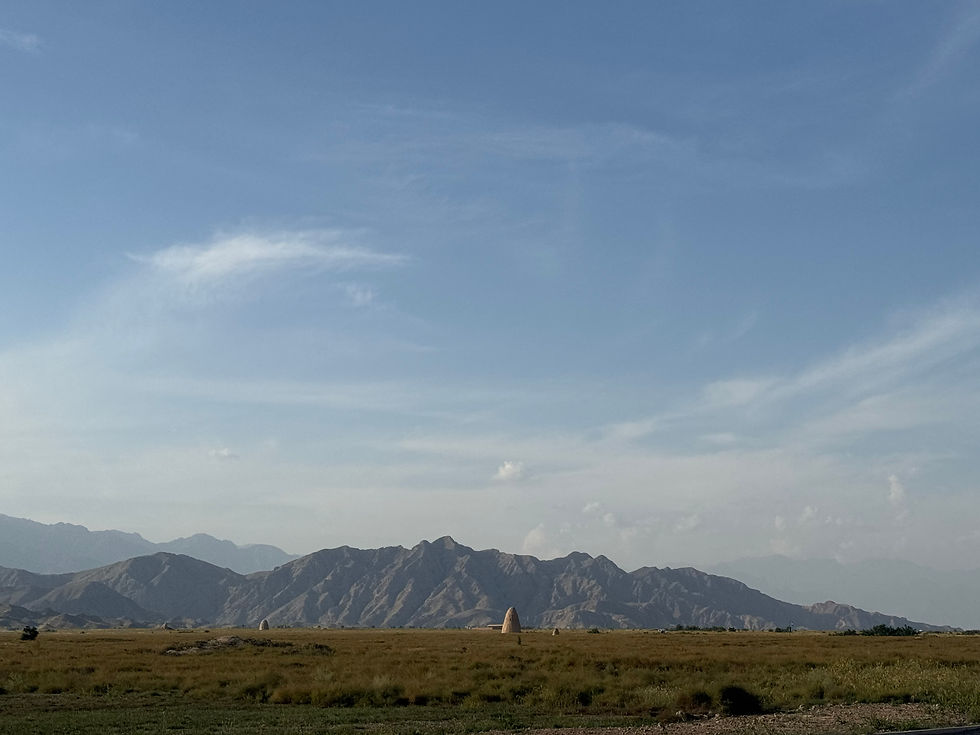
You can see the mausoleums from afar on the electric shuttle, with the Helan Mountains in the background.
Most visitors only visit Mausoleum No. 3, and I did too. To be honest, I felt that was enough. Considering that it’s still a tomb site, I didn’t want to wander too far, especially since there weren’t many other tourists around. Maybe it’s just me being a little superstitious, but I also think it’s important to be respectful in such places. After all, this was once the resting ground of emperors, and even though centuries have passed, there’s still something solemn about standing before these ancient mounds of earth.

The most prominent of the nine imperial tombs — Mausoleum No. 3, believed to belong to the first emperor Li Yuanhao.

The late-afternoon sun hanging high above Helan Mountains.
Beside Mausoleum No. 3, there’s another popular spot often referred to as the “twin mausoleums” — Mausoleums No. 1 and No. 2 (一号陵 and 二号陵) — which are located close together. These are believed to belong to Li Jiqian and Li Deming, the grandfather and father of Li Yuanhao. Because of their visual prominence, the twin tombs often appear in photography and even film shoots, standing side by side against the backdrop of the desert plain.
Even if you choose not to visit the rest of the mausoleums, it’s still an impressive sight. As the electric shuttle drives across the open plain, you can see the other tomb mounds scattered in the distance, framed by the Helan Mountains under the wide Ningxia sky. Along the way, a recorded narration plays in the background, giving short introductions to the tombs you pass by.
HUAIYUAN NIGHT MARKET (怀远夜市)
By evening, I returned to Yinchuan (银川) and made my way to Huaiyuan Night Market (怀远夜市). The air was thick with the scent of grilled lamb, cumin, and sweet pastries and I had a really hard time deciding what to buy. That’s one of the small downsides of solo travelling: you can’t try everything when there’s no one to share the portions with, and I don’t have the biggest appetite to begin with.

Huaiyuan Night Market glowing brilliantly at night, drawing crowds in with its neon lights and festive atmosphere.
After circling the stalls for a while, I finally settled on a few things to bring back to the hotel: crispy potato pancakes (土豆饼), egg & milk fermented rice drink (牛奶鸡蛋醪糟饮料), mala wide noodles (辣宽粉), pan-fried prawn dumplings (大虾锅贴), and La Hu Hu (辣糊糊).

Long rows of food stalls stretching endlessly under bright red lanterns, with locals and travellers slowly streaming in as the sky begins to dim.
These are the stalls that I bought the food from if you are interested!

Crispy potato pancakes (土豆饼) stall. The pancake is made from freshly grated potatoes mixed with a light seasoning and pan-fried until golden. The outside is crisp and slightly crunchy, while the inside stays soft and fluffy. It is sprinkled with spices, giving a savoury, comforting bite that’s simple but surprisingly addictive.

Egg & milk fermented rice drink (牛奶鸡蛋醪糟饮料) stall. This is a warm, comforting dessert drink made from sweet fermented glutinous rice, gently cooked with milk and beaten egg. It has a light, porridge-like texture with soft rice grains, a mild sweetness, and a subtle tang from fermentation.

Mala wide noodles (辣宽粉) stall. The mala wide noodles were coated in a glossy, spicy sauce, with a subtle nuttiness from what tasted like sesame or peanut paste, which mellowed the heat and made the dish unexpectedly comforting.

Pan-fried prawn dumplings (大虾锅贴) stall. These are freshly made dumplings filled with juicy prawn paste, and mixed with vegetables. They’re cooked on a flat pan until the bottoms turn golden and crisp, while the tops stay soft and tender. Can never go wrong with dumplings!

La Hu Hu (辣糊糊) stall. La Hu Hu is a beloved Ningxia street food made by simmering assorted vegetables, tofu, glass noodles, and meat in a thick, spicy chilli-based broth. Very hearty!

My yummy dinner!
My driver had actually given me a list of food recommendations. Some of her suggested night market must-tries included beef pancakes (牛肉饼), lamb skewers (羊肉串), La Hu Hu (辣糊糊), and Huaiyuan spicy strips (怀远辣条). She also mentioned a few of Yinchuan’s signature dishes that locals love, including Guoqiang hand-grabbed mutton (国强手抓), boiled lamb in ice soup (冰煮羊), old roundabout lamb offal soup (老转盘羊杂碎), and red willow branch barbecue (红柳枝烧烤), where the meat is grilled over fragrant red willow skewers.
I didn’t try any mutton or beef dishes since I’m personally not a fan, but if you enjoy them, Yinchuan is definitely the place to indulge.
A DAY IN SUMMARY...
It felt like I saw two very different sides of Yinchuan. One solemn and contemplative while the other lively and full of flavour, yet both deeply rooted in the land and its people. As I returned to the hotel with a bag of food and a head full of stories, I felt grateful for this unhurried day, one that allowed me to slow down, observe, and appreciate Ningxia not just as a place on the map, but as a living landscape shaped by time, memory, and simple joys.
Love,
Shu


Comments