
Chongqing Day 6: Tianyan Cave, Hong'ensi, TESTBED2, Liziba & Hongyadong by Night
07 September 2026
LAST DAY IN CHONGQING
Since it was my last day in Chongqing, we were determined to make the most of it. We started with a cave descent at Tianyan Cave, then spent the rest of the day fitting in photos, food, café breaks and a few of Chongqing’s famous sights. With Hongyadong’s evening lights on our list, we had plenty of time to explore before nightfall, and somehow filled every bit of it!
TIANYAN CAVE (天眼洞)
For our final day in Chongqing, we met up with our photographer again and headed to Tianyan Cave (天眼洞). Chongqing certainly has plenty of unusual photo experiences, from futuristic rooftop shoots against the skyline to motorcycle-themed setups. We didn't have enough time (and also the energy) to try out all the photo experiences, and we thought the cave offered something a little different, so we chose this one.
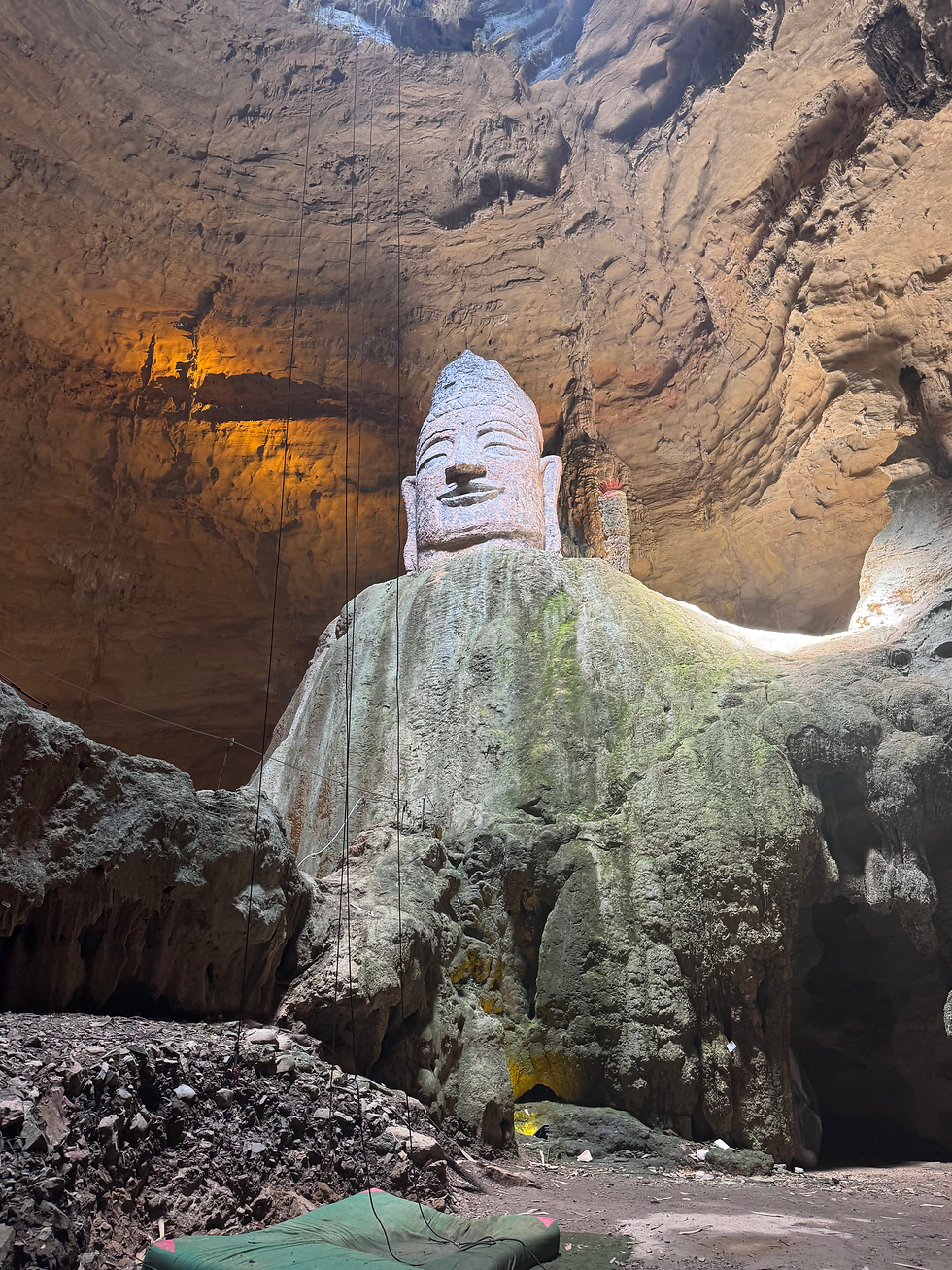
Our dramatic backdrop at Tianyan Cave (天眼洞), with a giant Buddhist sculpture beneath the towering cave walls.
The main experience involved being lowered by rope through an opening into the cave, with opportunities for photos during the descent. There are different packages available, including options with via ferrata activities for those who want more of a physical challenge. We chose the cave descent. Before starting, we had to tie our hair up. The staff provided a hair tie if we didn’t have one, which was handy.
You can arrange photography at the attraction or bring your own photographer. Ours recommended bringing someone independently because we could get more photos. However, after reviewing our pictures and watching the attraction’s photographer at work, I felt their photographer might be more experienced in getting a better angle for the descent shots. They also had props available, although those weren’t particularly important to me.

My little silhouette against an enormous cave backdrop.
When we arrived, we were the only visitors there. Another couple came along later while we were taking photos and looking around, but otherwise, it felt as though we had the place to ourselves. I’m not sure whether we had simply picked a quiet time, but it was lovely to explore the cave afterwards and take photos around without a crowd. The couple tried the via ferrata route, which looked rather intimidating to me!

Coloured lights illuminating the cave’s textured walls and rock formations.

Turquoise water, colourful lighting and a little boat waiting at the water’s edge.
I had initially worried that descending into the cave would be scary, but the staff lowered me very slowly. There was no free-falling sensation at all. For me, the most nerve-racking moment was leaving the platform. Once I was suspended, it felt much gentler than I had expected.
A snippet of the speed of the descent.
What I hadn’t anticipated was how uncomfortable holding the backward-leaning pose would become. My back started to ache, and because we were moving so slowly, I couldn’t quite judge how close I was to the ground. At one point, I brought myself upright for a break, only to realise I still had some distance to go, so I leaned back again.
Unfortunately, I later realised I had sat up just as I reached a particularly good spot for photos. Slightly unfortunate timing! Still, the descent was far less frightening than I had imagined, and it made for an unusual final-day experience in Chongqing.
Chongqing has plenty of other photo experiences too. One of my friends tried the motorcycle night-video shoot you might have seen on social media. She browsed Instagram and Xiaohongshu, chose a rider she liked the look of and contacted him directly to arrange the shoot. According to her, customised requests, such as a particular outfit or having the rider appear shirtless, cost extra. There really does seem to be a package for everything! She also approached a studio to film her own short drama, which seems really interesting as well. All these she did on her remaining solo days in Chongqing. If photography and videography are things you are interested in, you might want to keep an eye out for these experiences.
HONG'ENSI FOREST PARK (鸿恩寺森林公园)
After Tianyan Cave, we headed to Hong’ensi Forest Park (鸿恩寺森林公园). Our photography arrangement included a short shoot at another location, so we chose this as our next stop and spent about an hour there.
Despite the name, the main landmark here is Hong’en Pavilion (鸿恩阁), rather than an active temple. It was quiet during our visit, with relatively few people around, which made it pleasant for taking photos.

A grand stone gateway at the top of the steps, surrounded by greenery at Hong’ensi Forest Park.
The traditional-style architecture made a lovely backdrop for our shoot. The pavilion is known for its nighttime illumination, and I can imagine that the pavilion would look quite striking lit up against the night sky, so an evening visit would offer a different atmosphere.

Hong’en Pavilion (鸿恩阁), with tier upon tier of green-tiled roofs and elegantly upturned eaves.

Brightly painted beams and ceiling panels framing a wall of golden Chinese calligraphy.

An elaborate ceiling above a surprisingly open and quiet interior. We had plenty of space to look around.

Looking out across the river, bridges and layers of buildings from the top of the pavilion.

A sweep of green-tiled roof above the treetops, with the city stretching into the distance.

Green-tiled eaves framing the high-rises beyond. A lovely view from Hong’en Pavilion.

Following the pavilion’s covered walkway beneath layers of painted beams and curling green eaves.
JIU GUO YI TANG (九锅一堂) & LI RUO TAO (李若桃)
Then it was finally time for lunch! We hadn’t researched where to eat, so we relied on our photographer’s recommendation again and headed to Jiu Guo Yi Tang (九锅一堂) in Guanyinqiao.

九锅一堂, our photographer’s recommendation for lunch in Guanyinqiao.

Paper parasols overhead and wooden furnishings giving the dining area a traditional touch.
We ordered 酸菜鱼, fish in a sour broth with pickled mustard greens; 番茄炒蛋, stir-fried tomatoes and eggs; 花椒鸡, a chicken dish with green peppers. There was also a century egg and green chilli dish served in a mortar, with a pestle for us to mash everything together. I believe this was 擂椒皮蛋. It's my first time trying this dish. The food was really good and filling.

Lunch at 九锅一堂: suancai fish (酸菜鱼), tomato and eggs (番茄炒蛋), chicken with green chillies (花椒鸡), and century eggs with mashed chillies (擂椒皮蛋). Quite a spread for the three of us!
We also finally tried Li Ruo Tao (李若桃), a yoghurt drink shop we had kept seeing throughout the trip. I’d heard good things about it, and it was indeed delicious! I chose the 草莓桃儿白糯米酸奶奶昔, a strawberry and peach yoghurt shake with white glutinous rice. It was good, and normally this would probably have been my preferred flavour. But in Chongqing’s heat, I was craving something refreshing to cool me down and quench my thirst, so I felt like my friend's original version seemed to taste a little better that day.

Our drinks from Li Ruo Tao (李若桃).
TESTBED2 (鹅岭贰厂文创公园)
After lunch, we headed to TESTBED2 (鹅岭贰厂文创公园), a former printing factory transformed into a creative district. The former factory buildings give the place an industrial feel, while the little shops, cafés and creative displays make it a fun, photogenic place to explore. There were plenty of souvenir shops to browse as well, so we took our time wandering around.

A bright red storefront with “重庆” in gold. Hard to walk past without taking a photo!

A map of the area.

Tea bundles in illustrated wrapping, piled into a giant bamboo basket.

Colourful signs hanging above a narrow lane between the old factory buildings.

“Come back to the future.” A wall of old televisions, radios and other electronics making quite the nostalgic display.

A panda waving from a turquoise storefront. Another little distraction while browsing.

A nice photospot, with the words TESTBED2 painted on the road.

A smartly dressed rabbit welcoming visitors into a theatrical-looking little tea shop. We bought lots of tea here!

Old-fashioned signs, cassette displays and a red motorcycle outside a wonderfully nostalgic shopfront.

An orange staircase spelling out “贰厂重庆.” Even the steps doubled as a photo spot.

A railway-style sign for Caiyuanba Station, with colourful locks hanging along the railing behind it.

A giant teddy bear taking a café break beneath shelves of cups and little ornaments.
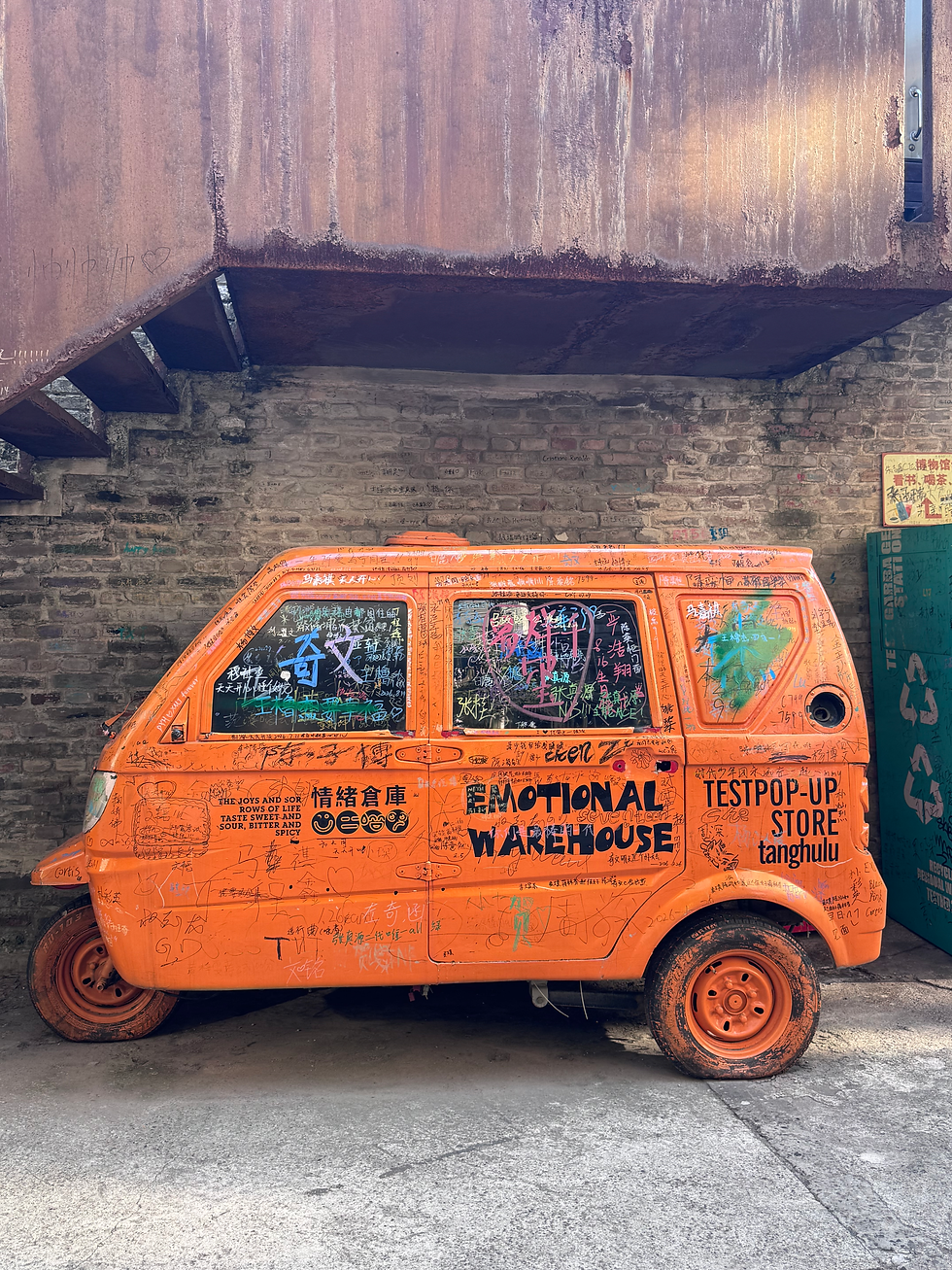
An orange three-wheeler covered in scribbles and messages, parked beneath the old factory structure.

“Financial freedom.” A collection of old safes forming TESTBED2’s very own vault wall.

“禁止焦虑”, or “No anxiety allowed.” A wall of old televisions offering a little reassurance in pink neon.
Eventually, the heat drove us into Er Xiaojie De Jia (二小姐的家) for a café break. The place was so beautifully decorated that practically every corner looked like a photo spot. Quite a few visitors were moving around taking pictures, and I could understand why!

A cheerful jumble of signs marking the way to 二小姐的家, our next escape from the heat.

Following the wooden steps into a leafy little hideaway at 二小姐的家.

A little corner of music memorabilia, with Jay Chou taking pride of place above the shelves.

Our drinks beside a tank of bright orange goldfish.

A tiny Kiki on her broomstick, appearing to fly among the goldfish. Such a clever little display!

Wooden floors, arched doorways, a piano and warm lighting. So many inviting corners inside 二小姐的家.

A little cat claiming the best seat in the café.

An artwork of the cat. So cute!

Mismatched chairs and soft window light. The kind of corner where you could happily lose an afternoon.

A little fruit-market scene against a glowing sunset backdrop, surrounded by greenery.

Sunlight filtering through the leaves onto a quiet outdoor table. Tempting, if only it hadn’t been so hot!

二小姐的家, with a little guitar-playing character welcoming us outside. A lovely place to pause between sightseeing stops.
It was also a lovely place to sit down, cool off and take a breather after exploring. I’d recommend stopping here if you enjoy pretty cafés, whether you’re hoping to take photos or simply relax for a while.
LIZIBA (李子坝)
Next, we headed to Liziba (李子坝) to see the famous monorail passing through a building. Looking back, we really packed a lot into our final day, although starting early certainly helped!

An unexpected sunset treat at Liziba, with warm peach skies above the river and skyline.
We didn’t spend too long here, but we did attempt one of those videos where you appear to “swallow” the train as it approaches. Unfortunately, ours didn’t quite work. We kept wondering why the train looked so enormous compared with our mouths! It seems like for the “swallowing the train” effect, shooting from across the river along Beibin Road (北滨路), where the train appears smaller might be better.
We were at the main viewing platform, which was great for watching the train pass through the building, but we couldn’t get the perspective right for that particular trick. In the end, I was happy enough to capture the train going through the building. Viral video attempt unsuccessful, but the sight itself was still fun to see!
The famous train passing through a building at Liziba (李子坝). We failed at the “swallowing the train” video, but I was happy enough to capture this!
HONGYADONG (洪崖洞)
We have squeezed so many stops into this day because we wanted to wait until evening to see Hongyadong (洪崖洞) illuminated. We had expected the lights to come on around 7 pm, but they were already on before then!
We had been told that we could enjoy the view of Hongyadong away from the crowds at Jiangtan Park (江滩公园). Unfortunately, we entered another place with a similar name into the navigation. Our car seemed to be taking us farther and farther from Hongyadong, until my bewildered friend finally asked the driver where we were going. After sorting out the confusion, our driver dropped us off near Grand Theatre Station (大剧院站). We decided against visiting the park in the end, as we learnt from our driver that for first time visitors wanting to get that classic, closer angled view of Hongyadong, Qiansimen Bridge (千厮门大桥) is still better. We didn’t make our way there ourselves, though, so I couldn’t compare the two viewpoints personally. The road towards the bridge was closed, although I’m not sure why, so we continued on foot to find a viewpoint.
We eventually found somewhere with a full view of Hongyadong, although it looked rather small from that distance. Qiansimen Bridge is supposed to offer a much better angle, but reaching it meant more walking and then making our way back afterwards. By that point, we weren’t feeling particularly motivated to put in the extra steps just for a photo.

Hongyadong (洪崖洞) glowing gold beneath Chongqing’s towering skyline, with the red-lit bridge beside it.

A closer look at Hongyadong’s tiered rooftops, outlined in golden light.
If I had been travelling solo, I probably would have kept going. My usual motto is 来都来了: since I’m already here, I might as well! This time, though, we were happy to enjoy the illuminated buildings from where we stood.
AFU BENCH NOODLES (阿福板凳面)
After seeing Hongyadong, we headed to Afu Bench Noodles (阿福板凳面) at Shibati. I had wanted to try the traditional stool setup, where you sit on a little stool and use a taller bench as your table. It looked like such a fun, down-to-earth way to enjoy Chongqing noodles.
However, one of my friends wasn’t keen on the stools, so we chose regular tables and chairs instead. We went for bench noodles, minus the benches!

My yummy bench noodles (板凳面).
The noodles were delicious, and I would happily recommend them. The portion was very generous, though, especially after everything else we had eaten that day. I wanted to keep going because they tasted so good, but eventually persuaded myself to stop. A rare moment of restraint on this trip!
SHIBATI (十八梯)
The noodles place was at Shibati (十八梯), also known as the Eighteen Steps, so we thought we might as well explore the place after dinner.

A quick evening stop at Shibati Traditional Style Area (十八梯传统风貌区).

Shibati’s tiled rooftops glowing beneath the surrounding high-rises. Another layered view of Chongqing by night.

Warmly lit wooden buildings stacked along the hillside at Shibati.

An impressive wall of ceramic jars outside a handmade yoghurt shop.

Following the lantern-lined stone steps through Shibati on our brief evening wander.
We stopped by the well at 古井春风. According to one story, Shibati got its name from the eighteen stone steps between an old well and the nearby homes. You will see visitors washing their hands here for good luck.

A stone well and wooden buckets tucked beside the evening walkway.

Glowing steps, leafy branches and red lanterns. A lovely little corner of Shibati after dark.

A ceiling of red lanterns leading towards a shadowy archway, which I believe leads to the Chongqing Shibati Grand Tunnel Site (十八梯大隧道遗址).
We managed about 15 minutes of wandering before one of my friends had a stomachache and we made an urgent trip back to the hotel. Thankfully it's not very far from our hotel!
AND JUST LIKE THAT...
My Chongqing adventures came to an end, with a slightly hurried return to the hotel after our brief wander through Shibati. Our final day had taken us from a cave to city streets, with plenty of good food along the way. This trip was a change from my usual solo travels, bringing shared decisions, unexpected experiences and plenty of moments to laugh about. I’m glad to have these memories with my friends, and now, a record of them here to look back on.
Note: We were leaving Chongqing on different days, so our itineraries went separate ways after this. On their last day together, my two friends watched Chongqing · 1949 (重庆·1949) and strongly recommended it afterwards. I didn’t watch it myself, but thought I’d pass along their recommendation if you’re looking for another experience to add to your itinerary.
Till my next adventure~
Love,
Shu


Comments